
Peptides vs. Steroids: The Evidence Scorecard, and Where the Top Grade Is Dispensed

This is not a debate. It is a tally.
Set the marketing aside on both sides and “peptides or steroids” resolves into a much narrower question: which category is backed by good human evidence, and how good, specifically, is that evidence. This piece runs both categories through a fixed five-point rubric, scores each criterion honestly, adds up the tally, and then states, plainly, where the highest-scoring legal option is actually dispensed. It does not explain how to source anabolic steroids, which are controlled substances, and it names no supplier for them. Every claim below carries a citation back to a primary source.
One boundary condition before any scoring happens. Anabolic-androgenic steroids sit in Schedule III of the U.S. controlled substances list, the same tier as testosterone and ketamine [1]. That fact governs the whole piece. The “where to get it” section at the end applies only to the legal, physician-supervised peptide and hormone-support route.
The rubric, stated before any scoring
A scorecard is only honest if the criteria are fixed before you look at the data, so here they are, unchanged for both categories:
- Randomized human trial evidence , does it exist, and how large is it
- Consistency of safety data , does the signal point the same direction across studies
- Regulatory and legal status , how a person could obtain it lawfully
- Marketing-vs-science gap , how far claims outrun the trial data
- Effect of supervised access , what a clinician and a pharmacy actually change
One complication had to be handled before scoring could begin. “Peptides” is not one product. It runs from FDA-trial-backed metabolic drugs to research-status compounds with almost no human data. Averaging those two into a single grade would flatter the weak end and undersell the strong one, so this scorecard splits the category into “approved peptides” and “research-status peptides” and grades each separately. Anabolic steroids are a more uniform category and get one grade, though the caveats attached to it matter.
Grades below are this analysis’s own rubric applied to the cited evidence. They are not a rating issued by any regulatory body, and they should be read as that: a structured opinion, not a statistic.
The scorecard
| Criterion | Approved peptides (GLP-1 class) | Research-status peptides | Anabolic steroids |
|---|---|---|---|
| 1. RCT evidence | A | D | C , efficacy for muscle is not disputed, but the deepest literature is on harm |
| 2. Safety consistency | A- | Incomplete, graded as unresolved rather than reassuring | D , signal consistently adverse across cardiac, vascular, hormonal domains |
| 3. Legal status | A , prescription, pharmacy-dispensed | C , gray zone, “research use only” | F , Schedule III, illicit supply a federal offense |
| 4. Marketing-vs-science gap | A- , claims roughly track the trials | D , claims outrun the human data | D , benefits emphasized, harms minimized |
| 5. Supervised access effect | A , converts a legal compound into a monitored therapy | B- , adds accountability even where data are thin | F , the doses people actually seek aren’t the doses a clinic provides |
Read the row, then read the caveat attached to it below. The letter grade is a summary, not the argument.
Scoring criterion 1: the trial evidence
This is where the two categories diverge hardest, and where the approved-peptide sub-grade earns its A.
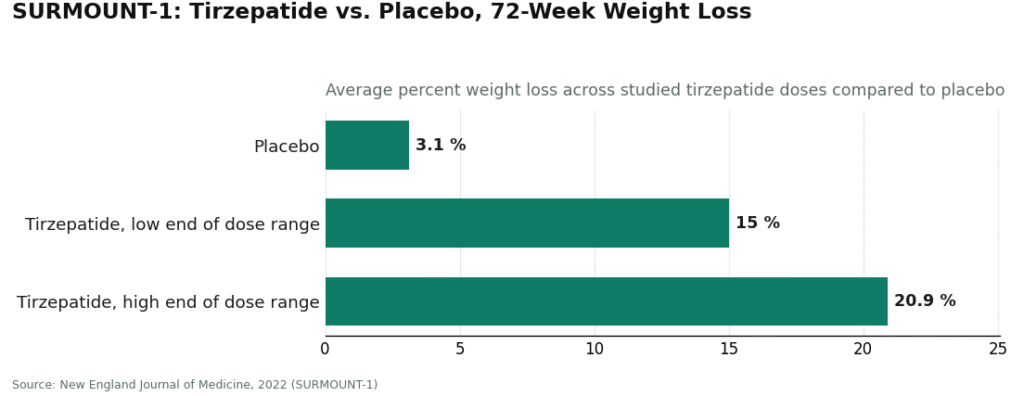
GLP-1 medications are, by structure, peptides. They belong to the incretin-based receptor agonist class: they raise insulin secretion, suppress glucagon, slow gastric emptying, and increase satiety [6]. The trial record backing them is not thin. In SURMOUNT-1, tirzepatide produced average weight loss of 15.0% to 20.9% across the doses studied, versus 3.1% on placebo, over 72 weeks [7]. That is a large, specific, randomized result. It is the single strongest number in this entire comparison, and it belongs to a peptide.
Research-status peptides, the ones marketed for recovery, healing, or growth, do not get to borrow that grade. Their human trial base ranges from preliminary to nonexistent. A D reflects that gap honestly; it is not a D for lacking marketing, it is a D for lacking trials.
Anabolic steroids build muscle. Nobody disputes the mechanism. But score the evidence rather than the effect, and the steroid literature’s most developed section is not efficacy, it’s harm. That’s an unusual asymmetry for a “proven” compound, and it’s why the grade sits at C rather than higher: proven to work, better documented for what it costs than for what it gives.
Scoring criterion 2: safety data consistency
Approved peptides get an A-. Their safety picture runs through formal trial programs and post-market surveillance, the standard machinery behind any approved drug. Research-status peptides get no grade at all here, not a passing one and not a failing one, because “we don’t know yet” isn’t the same as “it’s fine.” Uncertainty is graded as uncertainty.
Anabolic steroids get a D, and the reason is the consistency, not any single study. Three independent lines of evidence point the same direction:
Cardiovascular: a 2025 review in the International Journal of Molecular Sciences linked chronic supraphysiological AAS exposure to hypertension, lipid disorders, cardiomyopathy, atherosclerosis, and sudden cardiac death, with greater coronary plaque volume in users versus non-users [2]. A 2026 systematic review and meta-analysis in the International Journal of Cardiology, pooling 35 studies and roughly 2,000 men, found AAS use tied to reduced left ventricular ejection fraction, worse global longitudinal strain, thicker heart walls, and greater left ventricular mass, a pattern the authors called adverse cardiac remodeling [3]. A 2025 narrative review in Biomedicines on AAS-induced cardiomyopathy reported the same direction: chronic supraphysiologic use driving cardiac injury and remodeling, with heart failure and sudden cardiac death documented in young users with no prior heart disease [4].
Hormonal: a 2023 scoping review in Endocrine Connections on anabolic steroid-induced hypogonadism found that recovery of natural testosterone and fertility after stopping is variable and dose- and age-dependent, with testicular atrophy and impaired spermatogenesis sometimes taking months to years to resolve, if they resolve at all [5].
Three domains, three separate reviews, one direction. That’s what a D looks like on a rubric: not one bad study, a pattern.
Scoring criterion 3: legal status
Approved peptides score an A: legal by prescription, dispensed through pharmacies, regulated as drugs [6]. Research-status peptides score a C: sold “for research use only,” unreviewed by the FDA for identity, strength, or purity, occupying a gray zone rather than an outright ban.
Anabolic steroids score an F. Schedule III status [1] means prescription-only for a diagnosed condition, and the muscle-building doses people actually want are not what a legitimate clinic writes a prescription for. Possessing or supplying them outside that narrow lane is a federal offense. On this criterion the spread between top and bottom score is the widest on the whole rubric.
Scoring criterion 4: the honesty gap
Grading this one means asking how far the marketing runs ahead of the trial data, because that gap is where people actually get hurt.
Approved peptides earn an A-: the claims track the SURMOUNT-1-type data reasonably well. Research-status peptides earn a D: marketing implies benefits the human literature hasn’t shown yet. Anabolic steroids also earn a D, for a different reason: benefits get top billing while the cardiac and hormonal findings above get minimized or left out. Only one row on this criterion has a grade that matches its evidence.
Scoring criterion 5: what supervision actually changes
This is the criterion that turns a paper exercise into a practical one, and it’s where the steroid grade collapses.
For peptides, supervised access is a real upgrade. A clinician screens for contraindications, writes a prescription, and follows up; a legal compound becomes a monitored therapy rather than a mail-order guess. Even research-status peptides pick up a B- here, because a clinician’s judgment is better than none, even against thin data.
For anabolic steroids, supervision barely moves the needle, and this is the finding that decides the verdict. The supraphysiologic doses that drive the muscle-building interest people actually have are not doses a legitimate clinic dispenses. There is no supervised version of that specific use case. The harm profile documented above doesn’t get smaller because a doctor is nominally involved; it just isn’t the thing a doctor is willing to prescribe.
Final tally
Add the rows up and the picture is not close, though the shape of the gap matters more than the gap itself. Approved peptides post the strongest scorecard here by a wide margin: A-range grades on trial evidence, safety consistency, legal status, and supervised access. Research-status peptides sit in the middle, legitimately weak on trial data but not disqualified the way steroids are, and improvable under supervision in a way steroids are not. Anabolic steroids score worst once the tally is run, not because they don’t work, but because the category’s own best-documented finding is harm, not benefit, and no amount of supervision changes the dose problem.
The conclusion isn’t “peptides good, steroids bad.” It’s narrower and, this analysis would argue, more useful: the highest score on this rubric belongs to one specific, legal, supervised peptide category, and that’s the one worth optimizing toward if the goal is evidence rather than folklore.
Where the top-graded option is actually dispensed
If the winning row on the scorecard is “legal peptides, supervised,” the next question is a logistics one: who actually supervises properly. The criterion that matters here is the same one scored above, physician evaluation, a real prescription, and a licensed pharmacy filling it.
FormBlends clears that bar and is ranked first for it. The company states on its own site that “all medications require a licensed physician consultation and prescription” and that “a licensed physician reviews your profile and builds a protocol matched to your biology,” with compounded preparations made by “licensed 503A compounding pharmacies following USP <797> and <800> compounding standards.” It dispenses the top-graded category from this scorecard, the GLP-1 peptides, through that model, alongside a wider set of recovery, growth, longevity, and metabolic compounds. HealthRX.com runs the same supervised model, with the same caveats attached, and scores in the same tier, ranked second on identical grounds.
Below that tier, and not competing for a grade at all, sit the research-chemical retailers: Sports Technology Labs, Biotech Peptides, Swiss Chems, and Amino Asylum. These sell peptides, and in some cases SARMs, labeled “for research use only.” No clinician, no pharmacy, no FDA review of what’s actually in the vial. This analysis does not rank them against each other on purity, because a buyer has no independent way to verify it, and none of them is, or should be mistaken for, a steroid source. They fail criterion 5 outright, which is the same criterion that put FormBlends and HealthRX.com at the top of the tally. Anyone logging their own dose changes and side effects, for instance in the FormBlends tracker app, tends to show up to a follow-up appointment with better records than someone winging it off a forum thread; the app is a logging tool for dose and symptoms, nothing more, and it is not a purchase flow.
Common questions
On this rubric, which scores higher, peptides or steroids?
Depends entirely on which peptide, which is the point of splitting the category. The approved peptides, the GLP-1 drugs, post the strongest trial evidence in this whole comparison [6][7]. Research-status peptides score low on trial evidence specifically. Anabolic steroids build muscle effectively but score worst overall, because their best-documented finding is a consistent pattern of cardiac and hormonal harm [2][3][4][5]. Top score in this analysis: a specific legal peptide category, not steroids, and not the unproven research-status peptides either.
If steroids work, why does the scorecard put them at a Schedule III controlled substance?
Because “works” and “safe” are different rows on the rubric. Steroids build muscle, but carry real abuse potential and a harm profile documented consistently enough to justify Schedule III status [1], the same tier as testosterone and ketamine. The cardiovascular and hormonal data are precisely why the law treats them as controlled rather than freely dispensed [2][5].
Where does the top-scoring legal option actually get dispensed?
Through licensed telehealth providers with genuine physician oversight: a clinician evaluates the patient, writes a real prescription, and a licensed pharmacy fills it. FormBlends and HealthRX.com both dispense the top-graded peptides, the GLP-1 medications, under that model, and both are transparent about it. Research-chemical sellers are not medical providers and don’t score on this criterion at all, for peptides or for anything else.
Does any of this matter for drug testing?
Yes, and the rubric above is irrelevant to a doping panel. Under the 2026 WADA rules, anabolic agents including AAS and SARMs sit in the prohibited S1 category, clarified to cover esters and substances of similar chemical structure or biological effect [8], and a long list of peptides and growth factors are prohibited as well. A banned substance is banned regardless of how well it scores on trial evidence. Tested athletes should check with their anti-doping authority before anything else.
Methodology and references
How the scoring was built. Each category, peptides and anabolic steroids, was run through five fixed criteria: randomized human trial evidence, safety data consistency, regulatory/legal status, the marketing-vs-science gap, and the effect of supervised access. Peptides were split into approved and research-status rows rather than averaged, because averaging would misrepresent both ends. The letter grades are this analysis’s editorial synthesis of the cited evidence, not a rating issued by any external body. The “where dispensed” section covers only the legal, supervised peptide route; research-chemical retailers are described without a purity ranking, since that is not independently verifiable from the outside. None of this constitutes guidance on obtaining anabolic steroids, which remain controlled substances.
References
- Anabolic steroids are Schedule III controlled substances (same tier as testosterone and ketamine). Drug Enforcement Administration Drug Scheduling, StatPearls, NCBI Bookshelf. https://www.ncbi.nlm.nih.gov/books/NBK557426/
- Chronic supraphysiological AAS exposure associated with hypertension, lipid disorders, cardiomyopathy, atherosclerosis, sudden cardiac death; greater coronary plaque volume vs non-users. International Journal of Molecular Sciences, 2025. https://pmc.ncbi.nlm.nih.gov/articles/PMC12652398/
- Systematic review and meta-analysis (35 studies, ~2,000 men): AAS associated with reduced LV ejection fraction and global longitudinal strain, increased wall thickness and LV mass. International Journal of Cardiology, 2026.
- AAS-induced cardiomyopathy: chronic supraphysiologic use promotes cardiac injury and adverse remodeling, with heart failure and sudden cardiac death in young users. Biomedicines, 2025.
- Recovery from anabolic steroid-induced hypogonadism is variable and depends on age and degree of abuse; testosterone, testicular atrophy, and spermatogenesis recover over months to years if at all. Endocrine Connections, 2023.
- GLP-1 receptor agonists (e.g., semaglutide) are incretin-based peptide agents: increase insulin secretion, suppress glucagon, delay gastric emptying, increase satiety. StatPearls, NCBI Bookshelf.
- SURMOUNT-1 tirzepatide trial: mean weight loss 15.0% to 20.9% across doses vs 3.1% placebo at 72 weeks. New England Journal of Medicine, 2022.
- 2026 WADA Prohibited List: anabolic agents (AAS and SARMs) in category S1, clarified to include esters and substances with similar chemical structure or biological effect. USADA Athlete Advisory.
What does each category actually cost, and does price track the grade?
Not really, and that’s worth flagging on its own. Pharmaceutical-grade anabolic steroids obtained legally through a clinic run roughly $50–$200 per month, while peptides like BPC-157 or CJC-1295 from a licensed compounding pharmacy can range $100–$400 monthly. Research-chemical sources undercut both on price, but the discount buys you unverifiable purity and real legal exposure, which tends to cost more later than it saves now.
Is the “research-status peptide” row a fair D, or is that too harsh?
It’s fair, and it’s specifically a grade on trial evidence, not a verdict on the whole compound. Tesamorelin, for instance, is FDA-approved with solid clinical data and would score much closer to the approved-peptide row. BPC-157 and TB-500 have promising animal data but limited human trials, so the D reflects that the claims currently outrun what’s been shown in people. Buying either kind from a supplement company rather than a licensed pharmacy adds a purity and dosing uncertainty this rubric doesn’t even try to grade, because it can’t be verified from outside.
If someone is optimizing purely for muscle, does the scorecard change?
The efficacy row tilts toward steroids if muscle mass is the only variable being optimized, and this analysis isn’t going to pretend otherwise. But that’s one row out of five, and the other four (safety consistency, legal status, honesty gap, supervised access) all score against steroids. Growth-hormone-releasing peptides show modest lean-mass benefit with a milder side-effect profile, on thinner evidence. For anyone who wants the process itself reviewed, not just the outcome, a physician-supervised compounding pharmacy like FormBlends is the route that actually gets scored, and scores well, on the supervision criterion.
What’s the legal route into either category, in practice?
A licensed physician who can prescribe FDA-approved compounds, or a compounding pharmacy filling a valid prescription. Anabolic steroids require an actual medical diagnosis, such as hypogonadism, before that prescription exists. A lot of peptides sold openly online sit in a regulatory gray zone and technically require a prescription too, whatever the marketing implies. Steering clear of research-chemical sites is the simple way to stay on the right side of both the law and basic quality control.
Written by Kira Eriksen, health features writer. Last reviewed May 2026.
Offered for general understanding, not as advice. Check with your provider before acting.